



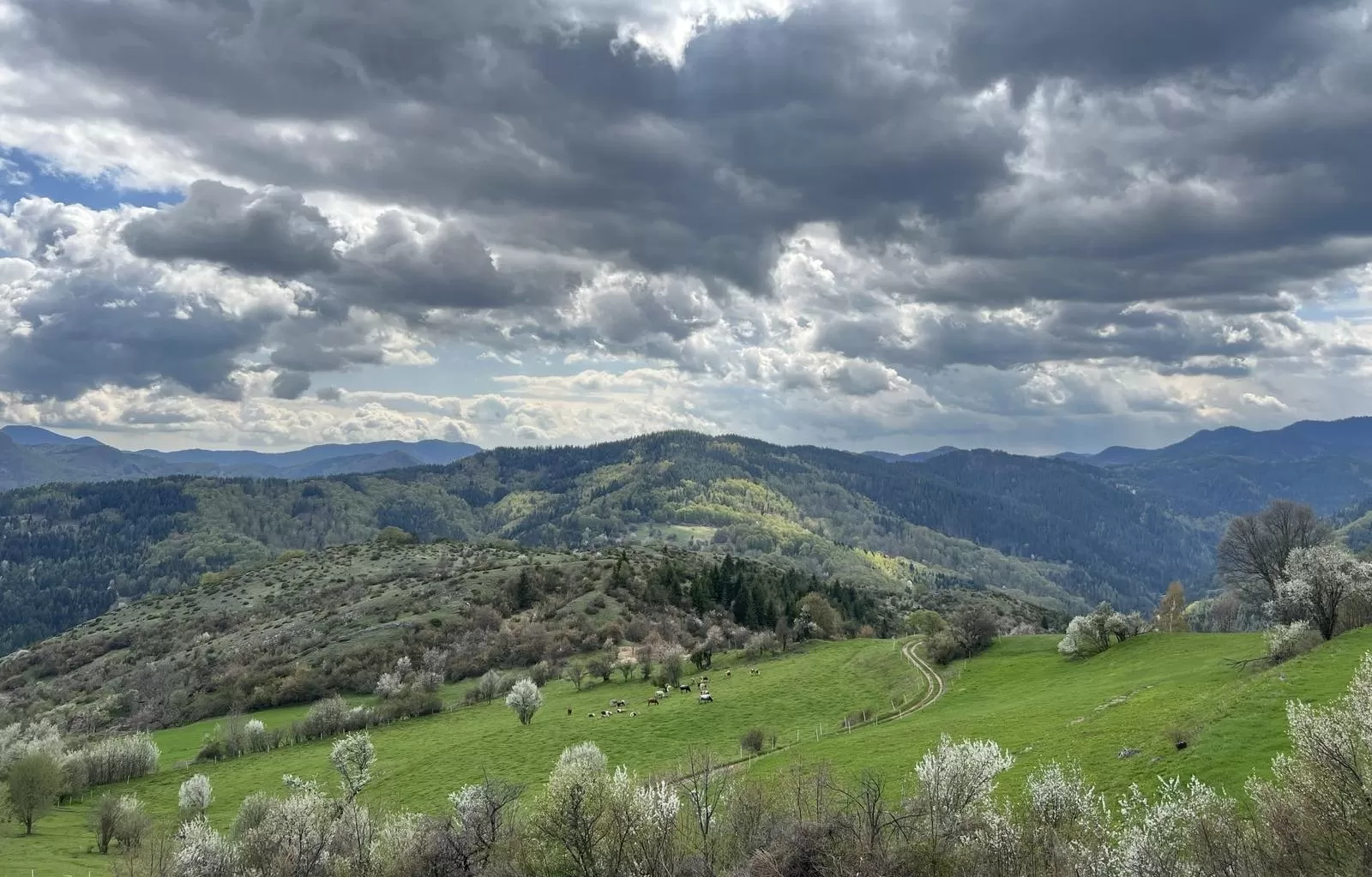
The Legend of the Rhodope Mountains
Ancient legends speak of a maiden named Rhodope, renowned for her extraordinary beauty, which captivated the hearts of all the gods. Each of them vied to possess her and to take her for themselves. The god Hemus, who was particularly jealous, did not want anyone else to see her and began throwing stones to build heaps that would conceal Rhodope from the eyes of both mortals and deities. According to tradition, it was from these stone heaps that the hills around Plovdiv originated. Despite this, the fame of Rhodope’s beauty did not wane. People and gods continued to come to see her, and anyone who glimpsed her fell in love instantly. Filled with rage and jealousy, Hemus, unable to protect her from prying eyes, turned her into a mountain.
According to another legend, the area where the Rhodopes now stand was once a vast plain covered with fragrant and beautiful roses. Persephone, the daughter of Zeus, frequently gathered roses there with her retinue. One day, enraged with his daughter, Zeus transformed the most beautiful of her companions, Rhodope, into a mountain.
A Thracian legend recounted by the Roman poet Publius Ovidius Naso reveals another story about the Rhodopes. In this tale, Rhodope was a mythical Thracian queen, and Hemus was her brother. They were children of a sea god and lived happily among endless fields, playing and singing all day. One day, they decided to disguise themselves as the oldest gods – those who ruled over waters, lands, birds, and animals. Hemus
fashioned a long white beard, and Rhodope let her golden hair flow freely. However, the old god, the ruler of the world, noticed them, became enraged, and turned the beautiful Rhodope into a mountain. When Hemus saw what had happened to his sister, he too was petrified. Since then, the brother and sister have been mountains – Hemus (the ancient name for the Balkan Mountains) and Rhodope, separated by a vast plain created by the vengeful old god.
Another legend suggests that the mountain was named Rhodope by an Egyptian pharaoh, who named it after his beloved, who was born in that region. On a coin minted in Philippopolis (Plovdiv) during the reign of the Roman Emperor Antoninus Pius (138–161 AD), Rhodope is depicted as a young and beautiful maiden reclining on a rock and holding in her hand the eternal flower of the Rhodopes – the saxifrage.
There is also a version that Hemus and Rhodope were young lovers, but they angered the gods, who turned them into stone.
Some sources suggest that the name Rhodope has Slavic origins, deriving from the words "ruda" and "ropa," which are associated with the ancient activities in the region – mining and metallurgy.
The legends of the Rhodope Mountains convey not only the beauty and grandeur of nature but also the deep emotions tied to human aspirations, love, and jealousy. Whether it is about the jealousy of the god Hemus, the wrath of Zeus, or the symbolism of Slavic names, these tales reveal the strong connection between people, mythology, and the land that inspired them. The Rhodopes remain not only a geographical phenomenon but also a cultural heritage, preserving the stories of generations who have sought to understand and convey the grandeur of this ancient mountain massif.