



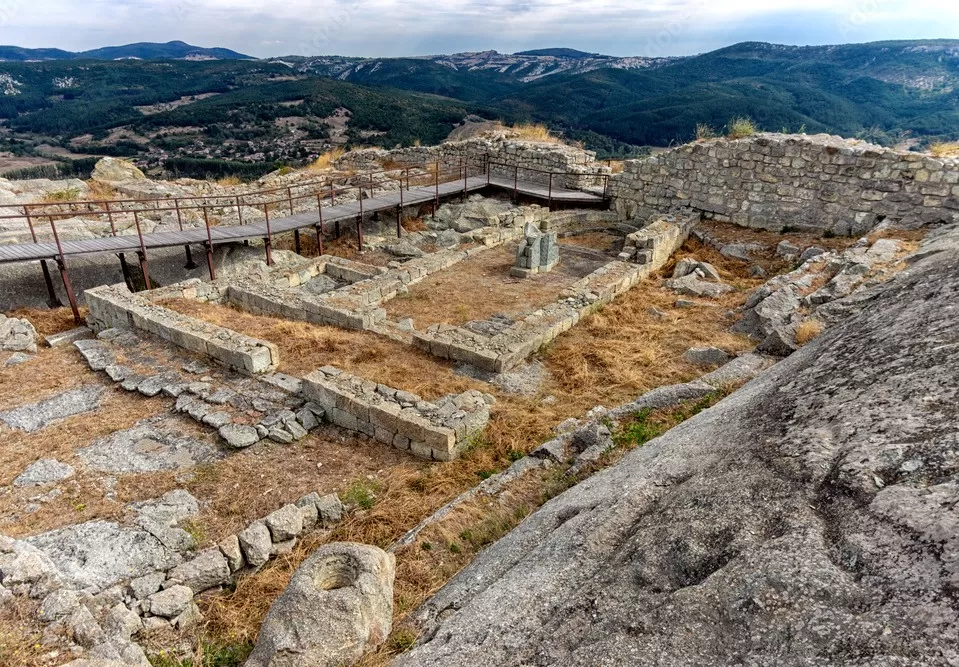
Perperikon: The Mysterious Sacred City
In recent years, one archaeological site has frequently appeared in the media—Perperikon. This ancient sanctuary gained prominence through the research conducted by the renowned Bulgarian archaeologist Nikolay Ovcharov. Despite this, there is still much to learn about its true nature, history, and significance. This text aims to address these questions.
Perperikon is a vast rock massif in the Eastern Rhodope Mountains, believed to have been established around 8,000 years ago. The stone monument rises 15 kilometers from Kardzhali, near the Perpereshka River, from which it is said that ancient people extracted gold. The archaeological complex was first described by Prof. Ivan Velkov in 1930, but it gained public attention due to the excavations led by Prof. Nikolay Ovcharov. His work significantly contributed to the media exposure of Perperikon, resulting in increased tourist interest in this sacred site. The extensive excavations revealed the Palace, the Acropolis, and other previously unknown sites. CNN even featured Perperikon in its reports.
Ancient inhabitants of these lands worshipped the Sun God from time immemorial. This is one reason they chose to settle on the large rock formation, due to its lack of vegetation and the convenient location for observing the rising sun every morning. With the advancement of tools and the refinement of implements during the Bronze Age, people began to process stone, carving various cult niches, sanctuaries, and tombs. Thus, Perperikon began to transform from its natural state. Numerous ritual vessels,
phialae, and ancient artifacts related to the Sun God have been found in some of these niches.
The sanctuary continued to gain significance during the Late Bronze Age, reaching its zenith between the 18th and 12th centuries B.C. This period coincided with the development of the first European civilization, represented by the Minoan-Mycenaean culture. The cult complex was further refined and equipped with a drainage system for water removal. One vessel from this period impresses archaeologists with depictions of their god and six human figures, symbolically rendered as flowers with heads represented as small suns. The Sun cult continued to evolve during the Early Iron Age (9th–6th centuries B.C.), with the emergence of other deities. Thracian religion, for instance, was strongly oriented towards the worship of Orpheus and Dionysus, and Perperikon became a center for these beliefs and practices.
During the Late Bronze Age, Perperikon evolved into a grand sanctuary. Many factors suggest that the famous sanctuary of Dionysus was located here. In antiquity, the oracle of Dionysus was as renowned as the oracle at Delphi, though there is no conclusive evidence that it was specifically located here.
According to legend, two fateful prophecies were made at the altar of Perperikon. The first predicted the great conquests and glory of Alexander the Great, while the second, made several centuries later, foretold the power of the first Roman Emperor, Gaius Julius Caesar Octavian Augustus. Suetonius describes the significant visit to the sanctuary by the father of the future first ruler:
"WHEN OCTAVIAN, THE FATHER OF AUGUSTUS, LED HIS ARMY TO THE REMOTE PARTS OF THE SACRED MOUNTAIN OF DIONYSUS, HE CONSULTED THE GOD'S ORACLE ABOUT HIS SON. THE PRIESTS CONFIRMED THAT HIS SON WOULD BECOME MASTER OF THE ENTIRE WORLD, AS THE WINE SPILLED ON THE ALTAR AND THE SMOKE RISED ABOVE THE TOP OF THE SANCTUARY UP TO THE SKY—A SIGN SIMILAR TO THAT RECEIVED BY ALEXANDER THE GREAT WHEN HE OFFERED SACRIFICE AT THE SAME ALTAR."
In 2002, a vast open hall matching the descriptions of Dionysus' temple in ancient texts was discovered. At its center is a majestic altar with a diameter of about 2 meters and a height of around 3 meters. Numerous carved pits filled with ceramic shards are noticeable on the altar. Fragments of smaller clay altars were also found at the base. Clearly, the hall lacked a roof to allow for the fire's flame, which was used for divination. The surrounding area and the summit of Perperikon are covered with
thousands of rock carvings in the form of basins, pools, and overflow channels. These altars were likely used for sacrifices to the gods. The monument’s imposing appearance with its myriad small altars and rock carvings was awe-inspiring. The functions of Perperikon declined during the Hellenistic period (4th–1st centuries B.C.), but in the 1st century, when Thrace was conquered by Rome, Perperikon experienced a true renaissance.
Perperikon comprises four main parts: the powerful fortress—Acropolis, the Palace-Sanctuary immediately southeast of the Acropolis, and the northern and southern outbuildings. Numerous temples and buildings were constructed on the hills. Wide streets were carved, allowing visitors to walk through. Alongside each street are houses carved directly into the rock. An enormous Basilica is carved in the eastern part of the Acropolis. This Basilica was likely an ancient temple that became a church during Christianity. A covered colonnade, or portico, leads from the Basilica into the interior of the Acropolis, with columns that have survived to this day. Ancient and medieval sources indicate that such porticos were constructed only in major cities and significant cult complexes. At this stage of exploration, two gates of the Acropolis have been discovered. One is from the west and is protected by a massive rectangular bastion. The other was excavated from the south in 2002. Its importance lies in its connection to the impressive Palace-Sanctuary.
The Palace was likely a temple complex dedicated to Dionysus, consisting of seven levels. At its center was a 30-meter ceremonial hall, probably used for rituals and ceremonies. Another notable feature in the Palace is a massive stone throne with footrests and armrests. Beneath the tiled floor of each room are thousands of channels for rainwater drainage, indicating a sophisticated sewer system for its time. The Palace is surrounded by a massive defensive wall, connecting to the Acropolis, together forming a unique ensemble.
Perperikon is a unique complex dedicated to the Sun God, symbolizing one of the earliest cultures in our lands. It was the birthplace of a religion that underpinned the development of culture, architecture, and knowledge. The discovery of Perperikon not only has moral significance but could also bring material benefits to the Bulgarian state, provided it is presented to the world in a worthy manner.
Author: Boyan Chipanov