



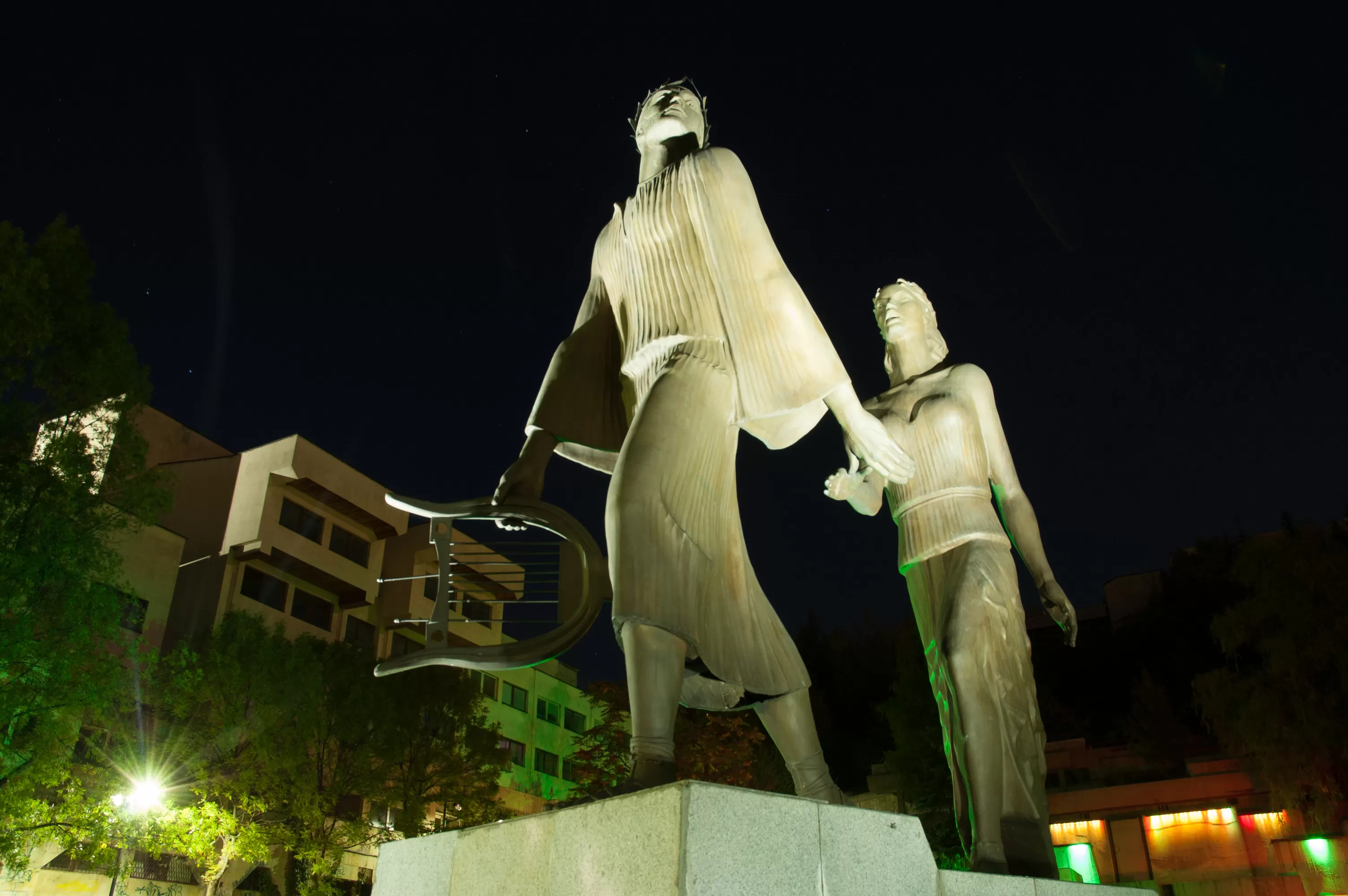
Orpheus and Eurydice: A Love Beyond Shadows
Once upon a time, in the lands of ancient Thrace, there lived the greatest singer, musician, and poet of his time — the legendary Orpheus.
Born of the river god Oeagrus and the muse Calliope, Orpheus was gifted with a divine talent. Legends say that when he played his lyre, nature itself would fall silent to listen — birds and beasts would freeze in place, the forests would bow their branches, mountains would part before him, snow would melt beneath the gentle sounds of his music, and even rocks would tremble with delight.
Courageous and inspired, Orpheus joined the Argonauts on their legendary quest in search of the mystical Golden Fleece. With the magic of his music, he drowned out the enchanting songs of the sirens and kept the rowers in rhythm, guiding the ship steadily toward success.
Yet Orpheus’s heart belonged to one alone — his beloved Eurydice. Their happiness, however, was fleeting. On the day of their wedding, fate struck cruelly: a serpent bit Eurydice, and its venom took her life. Shattered by grief, Orpheus could not bear the thought of losing his bride. Determined to defy death itself, he descended into the underworld to plead for her return.
Legends tell that Orpheus’s path to the realm of shadows led through the fearsome cave known today as the Devil’s Throat — a mysterious and dark passage into the underworld, where only the boldest dare to tread.
It was through this very place that he descended, guided by love and sorrow for his lost Eurydice. His music reached even the deepest corners of the underworld. The sound of his lyre — sorrowful, yet sublime — moved even the gods of shadows. Hades and Persephone, touched by his pain and his song, agreed to give him a chance: Eurydice could return to the world of the living, but under one condition — Orpheus must not look back until they had both emerged completely from the darkness.
And so, the two of them began their long and ominous journey toward the light. Silence surrounded them, broken only by the echo of their footsteps through the gloom. With each step, Orpheus’s heart grew heavier with unease. Was she truly behind him? Or had it all been a cruel illusion? The closer they came to the threshold of life, the more tormenting his doubt became. Then, just before they could cross the boundary between darkness and daylight, Orpheus gave in to his fear and turned. In that instant, Eurydice — still within the shadows — slipped from his grasp and fell back into the abyss, lost to him forever.
This moment broke Orpheus’s soul. For seven days he wept. He neither ate nor spoke, but sang the saddest songs the world had ever known. In the end, he returned alone to Thrace.
Four years passed since Eurydice’s death, and Orpheus remained true to her memory. He did not look at another woman, nor did he seek to love again. One beautiful spring morning, Orpheus sat atop a hill with his lyre at his feet. He picked it up and began to play. The world around him fell still once more, mesmerized by his melody.
Suddenly, wild laughter and cries pierced the air. The Maenads — ecstatic followers of the god Dionysus — came running toward him. One of them shouted:
— There he is, the woman-hater!
Overcome with fury, they began hurling stones at the singer. They attacked him mercilessly and tore his body apart. The pieces of his body were thrown into the River Hebrus, and his head, still singing, floated away with the current.
Thus, the divine singer passed from the world. But his soul did not remain alone. In the realm of shadows, he found Eurydice once more. When he saw her, he embraced her tightly and held her close. And from that moment on, Orpheus and Eurydice were together again — forever, beyond the reach of time or death.